The Liquidity Ratio: The One Number That Explains Why Wealthy Investors Get Stuck
Net worth measures what you own. The Liquidity Ratio measures what you can actually access. Most Indian family portfolios fail this test long before they fail any return test.
Executive Summary
There is a specific and recurring failure in Indian family wealth: a household with a large, genuinely valuable real estate portfolio that cannot fund an obvious opportunity, an unexpected obligation, or a generational transition without selling an asset at the wrong moment.
The portfolio was never poorly chosen. It was poorly proportioned.
The Liquidity Ratio is the single number we use to detect this before it becomes a forced-sale event. It is not a measure of return. It is a measure of freedom — the share of your total portfolio you could convert to cash inside 90 days without accepting a material discount.
The Investment Thesis
Illiquidity is a cost, and Indian investors systematically fail to price it.
Every allocation decision implicitly trades liquidity for expected return. Equities give up little liquidity; real estate gives up a great deal. That trade is entirely rational — provided the investor is compensated for it and provided the aggregate position is deliberately sized.
What we observe instead is accumulation by accretion. An apartment is bought, then a second, then a plot, then a commercial floor. Each decision is defensible in isolation. Nobody ever measures the aggregate. By the time the portfolio is 85% illiquid, the constraint is invisible until the day it becomes binding.
The Liquidity Ratio makes the aggregate visible while it can still be adjusted cheaply.
The Liquidity Ratio™
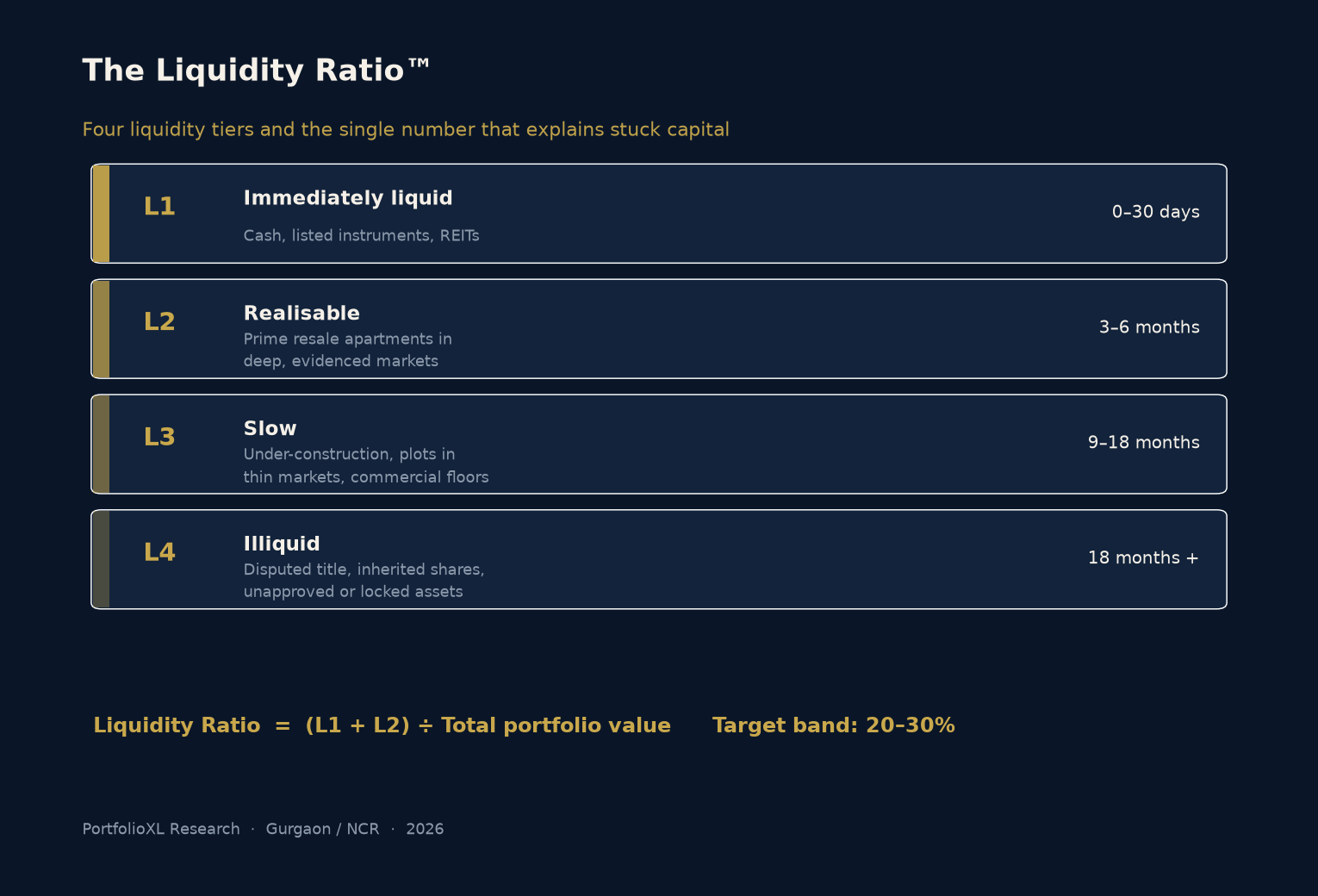
The Liquidity Ratio™ — four liquidity tiers and the single ratio that explains why otherwise wealthy portfolios become stuck.
Liquidity Ratio = (Assets convertible to cash within 90 days at less than a 5% discount) ÷ (Total portfolio value)
Assets are classified into four tiers, extending the ladder framework we set out in The Liquidity Ladder:
L1 — Immediate (0-7 days). Cash, liquid funds, listed equity, sovereign gold bonds on exchange.
L2 — Short (7-90 days). Listed REITs and InvITs, debt funds with exit loads, loan-against-securities headroom, and — importantly — undrawn, pre-sanctioned loan-against-property limits.
L3 — Medium (3-12 months). Ready, exit-prepared residential and commercial property in a liquid corridor with a clean title and a defined buyer set.
L4 — Long (12 months or more). Under-construction inventory, land, litigated or documentation-defective assets, jointly-held family property, unusually large or bespoke units.
The ratio counts L1 and L2 only. L3 is not liquidity; it is a plan. L4 is not liquidity at any timeframe that matters in a crisis.
Reading the ratio
Below 10% — fragile. Any material shock forces a distressed sale of the most saleable asset, which is almost never the asset you should sell.
10-20% — workable for an investor with strong, stable operating income and no near-term obligations.
20-30% — our recommended band for most HNI family portfolios. Sufficient to fund an opportunity or an obligation without disturbing the real estate allocation.
Above 40% — usually over-liquid unless a specific deployment or transition is imminent. Cash drag is a real cost.
The ratio should be re-tested annually and stress-tested against a simple question: if 20% of the portfolio value were required in 60 days, which asset would fund it, and at what discount?
Market Analysis: Why Indian Portfolios Skew Illiquid
Real estate is culturally treated as savings, not allocation. Property purchases are framed as permanent acquisitions rather than positions with a holding period. Permanence removes the question of proportion.
Success compounds the imbalance. The corridors that made investors wealthy — Golf Course Road, DLF Phases, central Gurgaon — rewarded holding for two decades. That history teaches accumulation and never teaches trimming.
Under-construction exposure is chronically misclassified. An investor with three under-construction units believes they hold three properties. They hold three L4 positions with staged payment obligations attached — negative liquidity until possession. Where those units sit in credible, funded projects the thesis may be sound, but the liquidity classification is not optional. We treat every under-construction allocation as L4 regardless of developer quality.
Leverage headroom is unmanaged. A pre-approved loan-against-property facility, arranged while income is strong and the asset is unencumbered, is genuine L2 liquidity. Arranged during a liquidity event, the same facility takes eight to twelve weeks and prices worse. Very few families set this up in advance.
NRI portfolios face an additional layer. Repatriation limits, TDS on sale consideration, and the timeline for a Section 197 lower-deduction certificate all extend the effective conversion period. An NRI-held Indian property that would be L3 for a resident is frequently L4 in practice. Our NRI strategy desk sizes this explicitly.
Portfolio Implications
Liquidity should be sized before allocation, not after. Determine the 90-day requirement first — obligations, opportunity reserve, family transitions — then allocate the remainder to illiquid compounding assets. Reversing the order produces the portfolios we are usually called in to fix.
Illiquid assets must clear a higher return hurdle. If liquid alternatives compound at 10-11%, an illiquid real estate position should be underwritten to a meaningfully higher expected return. If it cannot be, the illiquidity is uncompensated and the position is a preference, not an investment.
Diversify the exit, not just the asset. Four apartments in four different Gurgaon sectors look diversified and are not: they share one buyer pool and one local cycle. A portfolio spanning residential, commercial yield assets and listed instruments diversifies liquidity as well as return.
Build L2 deliberately. Pre-sanctioned credit lines, a modest listed REIT allocation and a liquid-fund buffer can lift a portfolio from a 6% ratio to above 20% without selling a single property. This is usually the fastest and least disruptive fix available.
Risks and Counterarguments
The bear case for high liquidity. Cash and near-cash underperform real assets across long horizons, and Indian inflation punishes over-liquidity. A permanent 40% ratio is a real cost, not prudence.
Liquidity is state-dependent. L3 in a normal market becomes L4 in a stressed one — precisely when it is needed. Any honest stress test should assume the medium tier is unavailable.
Who can safely run low. Investors with very high, stable operating income, no leverage and no near-term family transition can tolerate ratios below 10%. That is a narrower group than those who believe they belong to it.
What invalidates the framework. If Indian residential real estate develops genuine secondary-market depth — through fractional platforms, wider REIT coverage or institutional resale desks — the L3 tier could compress toward L2 and the recommended band would fall. We see progress here, but not yet at scale.
The PortfolioXL View
We believe liquidity, not return, is the binding constraint on most Indian family portfolios — and that it is almost never measured.
The most expensive real estate transactions we see are not bad purchases. They are good assets sold at the wrong moment by owners who had no other source of cash. The loss is not visible as a loss; it appears as a sale that simply happened at a lower price than it should have. Over a family''s lifetime, one or two such events can outweigh a decade of careful asset selection.
Our position is that every portfolio should carry a stated Liquidity Ratio target, reviewed annually, treated with the same seriousness as a return target. For most HNI families in our experience, 20-30% is the right band. Reaching it rarely requires selling property; it usually requires arranging credit facilities in advance, holding a modest listed allocation, and reclassifying under-construction exposure honestly.
Order of reasoning matters here more than anywhere else: liquidity before price, exits before entries, portfolio construction before project selection.
To calculate your own ratio and stress-test it, begin with our portfolio health check or speak with the advisory desk.