The PortfolioXL Value Creation Sequence: A Real Estate Investment Framework for Timing Any Corridor
Most investors do not lose money by buying the wrong location. They lose money by buying the right location at the wrong stage. A five-stage real estate investment framework for reading where any corridor sits in its economic lifecycle.
Investors spend months choosing a location. They spend almost no time asking where that location sits in its own economic lifecycle.
That imbalance explains more disappointing real estate outcomes than any other single factor we observe in client portfolios. The location was rarely wrong. The entry point within the location's development sequence was.
Executive Summary
Markets do not appreciate randomly. Value in real estate is created in a repeatable order: public infrastructure is committed, private capital follows, residents arrive, daily commerce forms, and only then does commercial value expand. Each stage prices in a different set of assumptions and carries a different risk profile.
An investor who understands the sequence does not need to forecast prices. They only need to identify which stage a corridor currently occupies, what the market has already paid for, and which catalyst remains unpriced.
This article sets out The PortfolioXL Value Creation Sequence™, the framework we use to evaluate emerging corridors, and applies it as an analytical method rather than a prediction.
> A corridor is not cheap or expensive. It is early or late. Those are different questions, and only one of them can be answered with evidence.
Table of Contents
1. Why location analysis is incomplete
2. The PortfolioXL Value Creation Sequence™
3. Stage 1 — Infrastructure Commitment
4. Stage 2 — Capital Deployment
5. Stage 3 — Residential Activation
6. Stage 4 — Economic Activation
7. Stage 5 — Commercial Value Expansion
8. Why investors enter too late
9. Applying the framework: reading SPR Gurgaon
10. The corridor decision checklist
11. Key takeaways
12. Frequently asked questions
1. Why Location Analysis Is Incomplete
The standard real estate investment strategy in India is location-first. Investors compare micro-markets, study connectivity, read about upcoming infrastructure, and select the corridor with the strongest narrative.
The analysis is not wrong. It is incomplete.
Two investors can buy identical assets in the same corridor eight years apart and record entirely different outcomes. The corridor did not change character. Its stage did. The first investor was compensated for accepting execution risk. The second paid for execution that had already occurred.
Location tells you whether value will be created. Stage tells you how much of that value is still available to you.
This is the distinction that separates a real estate investment framework from a location shortlist. Location is a static judgement. Stage is a moving one, and it is the only variable that changes what you should be willing to pay today.
2. The PortfolioXL Value Creation Sequence™
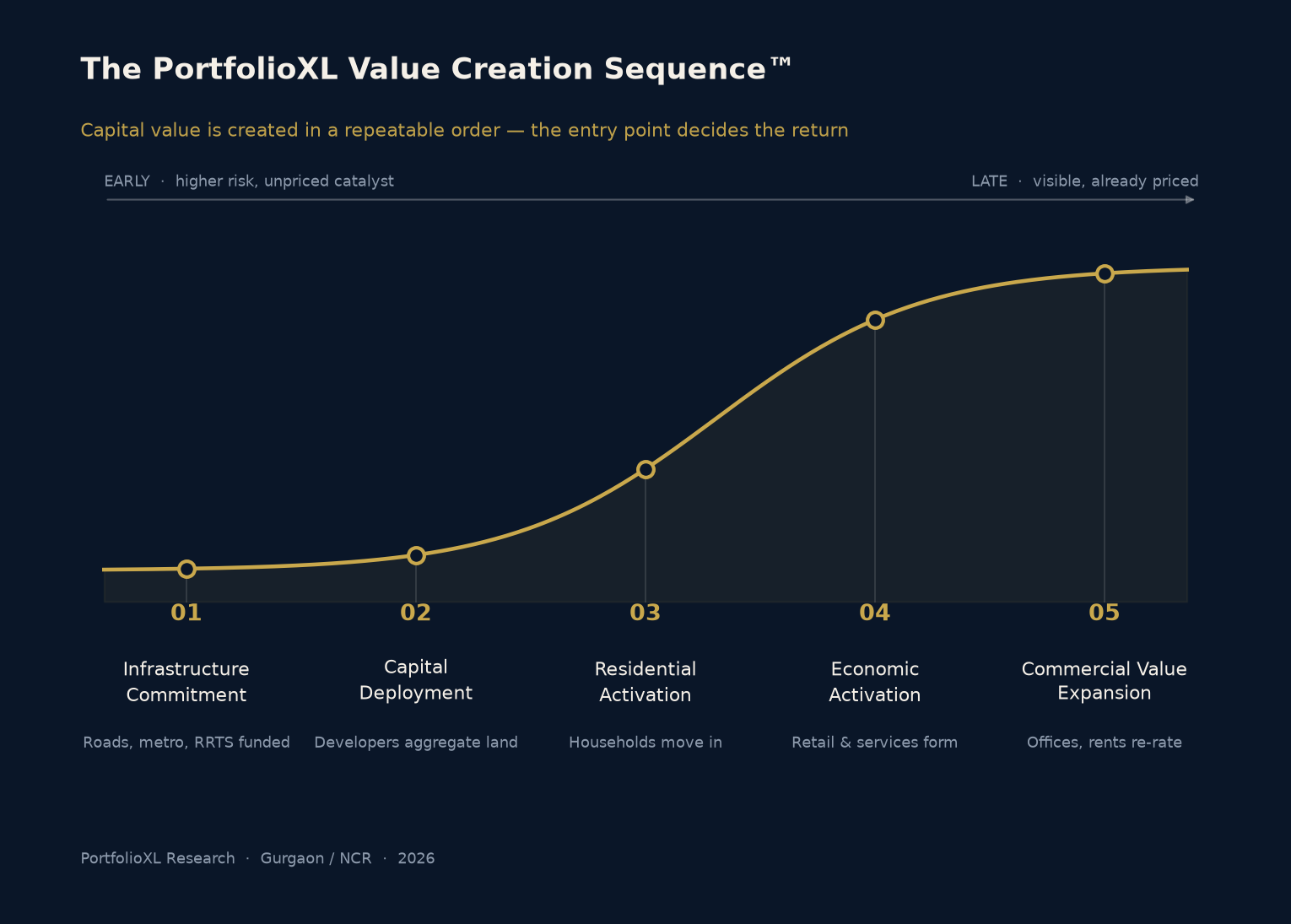
The PortfolioXL Value Creation Sequence™ — the five stages every corridor moves through, and where capital value is actually created.
Across eight years of working exclusively in one market, we have observed that corridors mature through five stages in a consistent order. The pace varies. The order does not.
| Stage | What is happening | What the market is pricing | Dominant risk |
|---|---|---|---|
| 1. Infrastructure Commitment | Roads, metro, policy, land use | Intent | Execution and delay |
| 2. Capital Deployment | Land buying, launches, construction | Future supply | Developer and completion |
| 3. Residential Activation | Possession, occupancy, community | Actual delivery | Absorption and vacancy |
| 4. Economic Activation | Schools, healthcare, retail, jobs | Daily demand | Density sufficiency |
| 5. Commercial Value Expansion | Rentals, offices, mixed-use | Cash flow | Cycle and interest rates |
Each stage resolves a specific uncertainty. The return an investor earns is, in substance, payment for absorbing the uncertainty that the next stage resolves. Once a stage is complete, that particular risk premium is no longer available at any price.
That is the mechanism behind the framework. Appreciation is not a reward for owning land. It is a reward for having accepted a risk that the market later removed.
3. Stage 1 — Infrastructure Commitment
Value creation begins with a public decision, not a private one.
A committed expressway, a sanctioned metro alignment, a notified land-use change, a funded rapid transit corridor, an approved sewage and power backbone — these alter the future economics of a location long before prices reflect the change.
Infrastructure-led growth works through travel time, not through announcements. When a corridor moves from ninety minutes to thirty-five minutes from an employment centre, it enters a different competitive set. It begins competing for households and employers who previously never considered it. That expansion of the addressable buyer pool is the true economic event.
What separates commitment from intention: budgetary allocation, awarded construction contracts, land acquisition completed, and visible site activity. A proposal in a master plan is not a commitment. A tendered and awarded package is.
At this stage prices are low because nothing has been proven. The risk is straightforward and honest: infrastructure in India slips. Timelines extend. Alignments shift. An investor entering here is underwriting the state's execution capability and needs the holding period to match — typically seven to ten years, not three.
4. Stage 2 — Capital Deployment
Private capital follows public capital. It does not lead it.
Once connectivity is credible, developers begin assembling land, securing approvals, and launching projects. Land transactions become larger and more institutional. Financing arrives. Cranes appear.
This is the stage most retail investors mistake for maturity, and it is the most important misreading in the entire sequence.
A launch is a supply event, not a demand event. It confirms that developers believe in the corridor. It does not confirm that residents do. Launch pricing reflects a developer's cost of land, cost of capital, brand premium and margin expectation. It does not reflect resale liquidity, rental demand, or the depth of the secondary buyer pool — because none of those exist yet.
The quality of the capital matters more than its quantity. A corridor absorbing capital from developers with completed delivery records, low leverage and the balance sheet to finish through a downturn will mature faster and with fewer stranded assets than one absorbing speculative land capital. When we assess under-construction developments, delivery history carries more analytical weight than design or amenity specification.
> Cranes signal conviction. Occupancy certificates signal completion. Occupied homes signal demand. Only the third one is evidence.
5. Stage 3 — Residential Activation
The corridor becomes real when people live in it.
Possession begins. Families move in. Lifts run, security is staffed, maintenance charges are collected, resident associations form. Vacant towers become neighbourhoods.
This stage is where the market's central error is exposed. Investors track launches because launches are publicised. Occupancy is not publicised, yet occupancy is what converts a construction site into an economy.
Residential activation matters for three reasons. First, it creates the rental market, and therefore the first genuine cash flow. Second, it creates the resale market, and therefore liquidity — an asset in a half-occupied corridor has a paper price but very few real buyers. Third, it creates the population base that every subsequent stage depends on.
Practical indicators of genuine activation: electricity connections energised, schools reporting local enrolment, functioning maintenance operations, waiting lists for rentals, and resale transactions closing between individual buyers and sellers without developer inventory competing in the same project. We examine these signals directly when assessing individual residential societies.
An investor who buys here pays for delivery certainty but is still early on demand. The remaining risk is absorption: will enough people actually live here, quickly enough.
6. Stage 4 — Economic Activation
Density creates commerce. Commerce creates permanence.
Once a critical mass of households is in place, daily economic life forms around them — schools, clinics and hospitals, pharmacies, grocery, restaurants, salons, service businesses, and eventually local employment. This is when a corridor stops being a place people sleep and becomes a place people live.
The economic significance is that demand shifts from speculative to organic. In earlier stages, buyers are investors purchasing an expectation. Here, buyers are end users purchasing utility. End-user demand is less volatile, less rate-sensitive at the margin, and far more supportive of a floor under prices.
There is a threshold effect. Retail and healthcare operators underwrite catchment population, not corridor optimism. Below a certain occupied-household density, commercial operators do not commit, and the corridor stalls in a frustrating middle state — delivered, partially occupied, and economically thin. Corridors do not fail at Stage 1 nearly as often as they stall at Stage 4.
For investors, Stage 4 is where the risk-return profile changes character. Much of the discovery is complete. What remains is compounding.
7. Stage 5 — Commercial Value Expansion
Commercial value is the output of the sequence, not the input.
Retail rentals rise because footfall is proven. Office demand arrives because a residential catchment reduces employers' talent-acquisition friction. Mixed-use development becomes viable because land economics now support it. Rental yields firm up because tenants have alternatives and still choose to stay.
This is the stage that produces the most attractive headlines and the most durable income. It is also the stage where the largest share of value has already been distributed to earlier entrants.
That is not an argument against investing at Stage 5. Commercial property investment in a mature corridor is a legitimate and often superior strategy for investors prioritising income stability, tenant covenant quality and predictability over capital appreciation. It is an argument against expecting Stage 1 returns while accepting Stage 5 risk. Those are different products.
The error we correct most often is not investors buying late. It is investors buying late while underwriting early-stage return assumptions.
8. Why Investors Enter Too Late
Four behaviours account for the majority of mistimed entries.
Buying after headlines. Media coverage is a lagging indicator. By the time a corridor is described as the next growth story, Stages 1 and 2 are typically complete and priced. Coverage follows transaction volume; it does not precede it.
Confusing launches with maturity. A dense cluster of new launches is often read as validation. It is more accurately read as future supply, which will compete directly with your resale when you attempt to exit. We have written separately on why exit planning must precede every entry.
Chasing momentum. Recent price appreciation is frequently used as evidence of future appreciation. In a staged market, sharp appreciation more often signals that a stage has just been completed — meaning a risk premium was just extinguished, not that another is about to be created.
Anchoring to the wrong comparison. Investors compare a corridor's price per square foot to a mature corridor and conclude it is cheap. The comparison is meaningless without adjusting for stage. A Stage 2 corridor should trade at a discount to a Stage 5 corridor. The question is whether the discount is proportionate to the risk that remains.
The common thread is that all four substitute sentiment for sequence. Timing within the sequence is more consequential than identifying a corridor that others describe as hot.
9. Applying the Framework: Reading SPR Gurgaon
We use the Southern Peripheral Road corridor here as a method demonstration, not a recommendation. The objective is to show what an investor should observe, not what conclusion they should reach.
Stage 1 evidence to verify: the status of the SPR widening and grade-separated works, the operational condition of the Dwarka Expressway interface, the sanctioned alignment and funding position of the proposed metro extension, and actual travel times measured at peak hours rather than quoted in brochures. Distinguish between what is complete, what is under construction with an awarded contract, and what remains a plan.
Stage 2 evidence to verify: how much of the current price reflects launches versus completions, the concentration of unsold primary inventory, and the delivery record of the developers holding that inventory. Heavy unsold primary stock is the single largest suppressant of resale pricing.
Stage 3 evidence to verify: occupancy rates in delivered projects, whether rental demand is genuine or driven by short-term corporate leasing, and whether individual-to-individual resale transactions are clearing at listed prices or at negotiated discounts.
Stage 4 evidence to verify: the presence of operating schools and hospitals rather than announced ones, whether organised retail has committed leases, and whether households living in the corridor conduct daily life inside it or commute out of it.
Stage 5 evidence to verify: whether commercial rentals are supported by occupied space or by pre-leasing to related entities.
An honest reading of most of the SPR belt will find that different pockets sit at different stages simultaneously. Corridor-level averages conceal this. Analysis has to be conducted at the sector and project level, which is how we structure our Gurgaon micro-market research.
The method transfers. The same five questions can be asked of any emerging corridor in any Indian city, and the answers are observable rather than speculative.
10. The Corridor Decision Checklist
Before committing capital to any corridor, answer these in writing.
1. Which stage is this corridor in? Support the answer with observable evidence — occupancy, operating amenities, awarded contracts — not with narrative.
2. What has already been priced in? List the events the current price assumes have occurred or will certainly occur.
3. What catalyst remains? Identify the specific unpriced event that will move this asset from its current stage to the next. If you cannot name it, you are buying beta, not alpha.
4. Is the demand organic or speculative? Estimate the proportion of transactions from end users versus investors. Speculative demand reverses quickly; organic demand does not.
5. What assumptions are embedded in today's price? Then invert the question: what has to go wrong for this thesis to fail, and how likely is it.
6. Does the holding period match the stage? Early-stage entries require long horizons. A three-year horizon on a Stage 1 asset is a mismatch, regardless of the quality of the corridor.
7. Who is the buyer at exit, and at what stage will the corridor be then? Your exit price is set by the corridor's maturity at the time of sale, not at the time of purchase.
A written answer to each is more valuable than any price forecast. Investors who wish to test an existing portfolio against these questions can begin with our portfolio health check.
11. Key Takeaways
- Value in real estate is created in a fixed sequence: infrastructure, capital, residents, commerce, commercial value.
- Return is compensation for absorbing the uncertainty that the next stage resolves. Completed stages no longer pay.
- Launches indicate supply and developer conviction. Occupancy indicates demand. Only the second is evidence.
- Corridors more often stall at Stage 4 for want of density than fail at Stage 1 for want of infrastructure.
- Commercial value expansion is the output of the cycle. Buying at Stage 5 is legitimate; underwriting Stage 1 returns there is not.
- Price relative to a mature corridor is meaningless without adjusting for stage.
- Holding period must be matched to stage, not to personal preference.
The PortfolioXL View
We believe the most valuable analytical skill in Indian real estate is not location selection. It is stage identification.
Location analysis has been commoditised. Every portal, every brochure and every advisor can describe a corridor's connectivity and infrastructure pipeline. Almost none can tell an investor, with evidence, which stage that corridor currently occupies and what the current price already assumes. That is where judgement still creates measurable value.
We also believe the framework should be used to say no more often than to say yes. Most corridors, at most moments, are fairly priced for their stage. The opportunity set is narrower than the market's enthusiasm suggests, and discipline about stage is what prevents an investor from paying twice for the same risk premium.
Counterargument, stated fairly: stages are not always cleanly sequential. Policy shocks, employment relocations and interest rate cycles can compress or reverse them. A corridor can complete Stage 2 and then stall for years if a large employment catalyst fails to materialise. The framework organises evidence and improves judgement. It does not eliminate uncertainty, and any advisor who claims otherwise is selling something.
Markets reward investors who understand sequence, not those who simply identify the right postcode. Location tells you where value will be created. Sequence tells you how much of it is still yours to earn.
PortfolioXL is an independent, RERA-registered real estate advisory. We do not represent developers and we do not earn developer commissions. Our work is limited to helping investors evaluate opportunities through structured analysis. Nothing in this article is a recommendation to buy or sell any specific asset. To discuss a corridor or an existing portfolio, speak with our advisory team.