The Dead Capital Framework: How to Identify the Assets Quietly Draining Your Real Estate Portfolio
Most underperforming property portfolios are not the result of bad purchases. They are the result of good purchases held too long. The Dead Capital Framework is how we identify, score and release capital that has stopped working.
Executive Summary
The single largest source of underperformance in Indian real estate portfolios is not the asset that lost money. It is the asset that stopped making money and was never sold.
We call this dead capital: equity that remains legally owned, emotionally comfortable, and economically inert. It shows up on a family balance sheet at a flattering historical cost, produces a token rent, appreciates at or below inflation, and consumes the one resource sophisticated investors have least of — deployable capital at the right moment in a cycle.
Across the portfolios we review, between 25% and 40% of total real estate equity is dead capital. Almost none of the owners describe it that way.
The Investment Thesis
Real estate returns are determined less by what you buy than by what you refuse to sell.
An investor who buys three good assets and holds all three for twenty years will materially underperform an investor who buys the same three assets, identifies the one that stalled at year six, and redeploys that equity into the next corridor at its entry stage. The second investor did not have better information. They had a disposal discipline.
Equity markets impose this discipline structurally: prices are visible daily, and stagnation is obvious. Real estate hides stagnation behind illiquidity, sentiment and the absence of a printed price. The Dead Capital Framework restores that visibility.
The Dead Capital Framework™
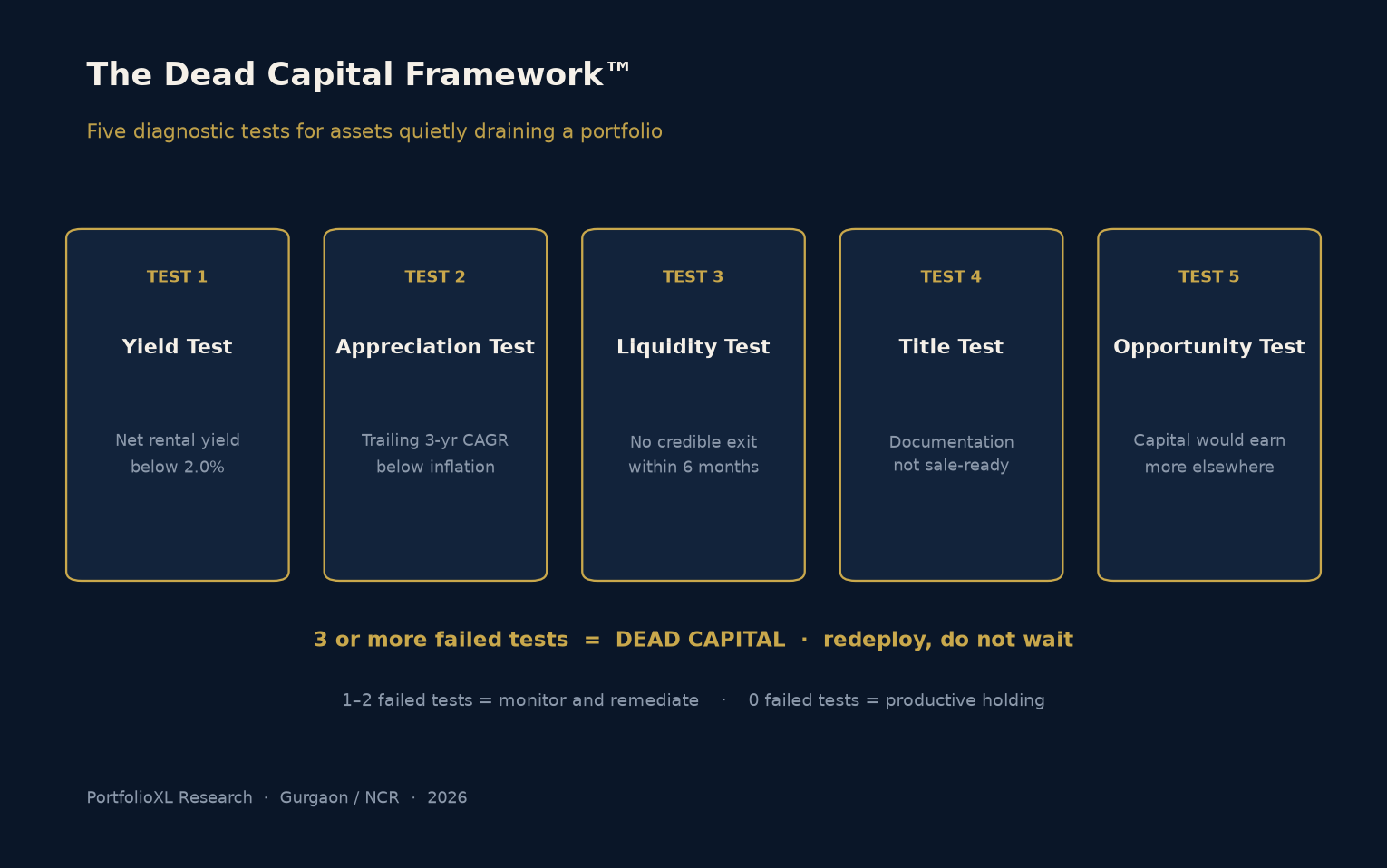
The Dead Capital Framework™ — five tests applied to every holding; three or more failures indicate capital that should be redeployed rather than held.
We score every holding against five tests. An asset failing three or more is dead capital and should enter a disposal review.
Test 1 — The Real Return Test. Is the asset compounding above 9-10% annually on current market value, counting appreciation and net rent together? Not on your purchase price. On what the equity is worth today. Capital is valued at what it could be, not what it was.
Test 2 — The Yield Reality Test. Does net rent, after maintenance, vacancy, property management and repairs, exceed 2.5% of current market value? A ₹4 Cr apartment producing ₹85,000 a month gross and ₹60,000 net is delivering 1.8%. That asset is a store of value, not an investment.
Test 3 — The Liquidity Test. Could this asset be sold within 90 days at no more than a 5% discount to fair value? If the honest answer is six months and a 15% discount, the paper value is fiction. Read our detailed treatment of this in The Liquidity Ladder.
Test 4 — The Cycle Position Test. Where does the asset sit in its corridor cycle? An asset in the late commercial stage of the Value Creation Sequence has already delivered its re-rating. Remaining upside is market beta, not location alpha.
Test 5 — The Redeployment Test. If you held the sale proceeds in cash tomorrow, would you buy this asset again at today''s price? This is the most uncomfortable and the most reliable question in portfolio management. It removes purchase price, nostalgia and sunk cost from the decision in one step.
Market Analysis: Why Dead Capital Accumulates in Gurgaon
Gurgaon''s two-decade appreciation story has been unusually kind to passive holders. Corridors like Golf Course Road and DLF Phase 1-5 re-rated so powerfully between 2005 and 2015 that holding was indistinguishable from skill. That history built a behavioural assumption that time alone produces returns.
It no longer does uniformly. The market has fragmented. Between 2022 and 2026, capital values on high-demand corridors such as Dwarka Expressway, SPR and New Gurgaon have moved at multiples of the rate seen in mature, fully-built pockets where new supply is limited but so is incremental demand. In the same city, in the same asset class, dispersion between the best and worst performing sectors has widened to a factor of three.
Three structural forces sustain dead capital:
Anchor pricing. Owners benchmark to the highest quote they ever received, not to the last transacted price in their tower. A gap of 12-18% between asking and transacting is common; that gap is what converts a sellable asset into a held one.
The maintenance illusion. Older societies carry rising maintenance, ageing services and periodic capital calls. These are treated as costs of ownership rather than as a negative yield adjustment. Properly accounted, they often turn a 2.4% gross yield into a sub-1.5% net yield.
Tenant profile decay. Rental demand follows employment geography. As office absorption shifted toward Golf Course Extension, SPR and Cyber City peripheries, several older residential pockets moved from corporate-lease tenants to individual tenants — lower rents, higher churn, longer voids. The capital value looks stable; the income quality has deteriorated.
Portfolio Implications
Dead capital is not primarily a return problem. It is an allocation problem.
Opportunity cost is the real loss. An investor holding ₹6 Cr of equity compounding at 4% instead of 11% forgoes roughly ₹5.5 Cr of terminal value over ten years. That figure never appears in any statement. It is the most expensive invisible line item in Indian family wealth.
Concentration is usually the hidden co-factor. Dead capital tends to cluster in the corridor an investor knows best, which is also where they are already over-allocated. Disposal therefore solves two problems at once.
Taxation should shape sequencing, not decisions. Long-term capital gains on property are taxed at 12.5% without indexation under the Finance Act 2024 regime retained in 2025, with a resident-only election to use the older 20%-with-indexation computation for property acquired before 23 July 2024. Section 54/54F reinvestment relief is capped at ₹10 Cr and Section 54EC bonds at ₹50 lakh. These provisions determine the order and structure of a disposal. They are a poor reason to keep an asset that fails four of five tests.
Redeploy into stage, not into story. Proceeds from a stalled mature asset belong in an earlier-stage corridor with visible infrastructure funding, or in a higher-yield commercial or under-construction allocation — not in a second unit in the same society.
Risks and the Bear Case
The framework can be misapplied, and we should say where.
Land is the legitimate exception. Undeveloped land in a documented infrastructure path produces no yield by definition. It fails tests 2 and 3 while being an entirely rational holding. Apply the framework to income-capable assets.
Transaction friction is real. Brokerage, legal costs, taxes and re-entry pricing can consume 8-12% of gross value. A disposal must clear that hurdle with margin, which is why we require three failed tests, not one.
The bull case for holding. If a corridor is on the verge of a genuine infrastructure unlock — a confirmed metro alignment, a funded expressway interchange, a large committed office campus — patience is correct. The test is whether the catalyst is funded and dated, or merely announced.
Who should ignore this framework. Owners whose property is primary residence, whose holdings are already liquid and yield-positive, or whose family circumstances make disposal disruptive. Portfolio optimisation must never override life design.
The PortfolioXL View
We believe most Indian real estate portfolios are over-owned and under-managed.
The industry is organised almost entirely around acquisition. Brokers are paid to sell, developers are paid to launch, portals are built to surface new inventory. Nobody in the transaction chain is compensated for telling an investor that the asset they already own has finished its job. That structural gap is precisely why dead capital persists.
Our advice is unglamorous and consistent: score every holding annually against the five tests, accept that one or two will fail, and treat disposal as an ordinary portfolio action rather than an admission of error. Selling a good asset at the end of its cycle is not a mistake. It is the mechanism by which the next cycle gets funded.
An investor who releases one dead holding every three years and redeploys it with discipline will outperform a peer with better taste in property and no exit rules. Judgement about when to leave is worth more than judgement about where to enter.
If you would like a structured view of which holdings in your portfolio are compounding and which have stalled, our portfolio health check applies this framework in a single review, or you can speak with our advisory desk directly.