The Exit Readiness Framework: Why Most Property Sales Fail Before They Are Ever Listed
Sellers lose more value in the six months before listing than in the negotiation itself. Exit readiness is a construction task, not a marketing task — and it begins years before the sale.
Executive Summary
The price an investor receives for a property is set long before a buyer is found.
By the time an asset is listed, most of the discount has already been created — by incomplete documentation, an unresolved encumbrance, a lapsed occupancy certificate, an unregistered lease, a co-owner who is unreachable, or an NRI seller who has not planned for TDS on the sale consideration. Each of these converts negotiable price into non-negotiable delay, and delay converts into discount.
We estimate that exit-unready assets transact 6-14% below comparable ready assets in the same tower. That gap is entirely self-inflicted and entirely preventable.
The Investment Thesis
Liquidity is not a property of an asset. It is a property of its paperwork, its income profile and its buyer set.
Two identical apartments on the same floor of the same building can have completely different liquidity. One sells in 45 days at fair value. The other takes nine months and closes 11% lower. Nothing about the physical asset differs. Everything about its exit readiness does.
This is why we insist that exit planning precede entry, a principle developed in The Liquidity Ladder. The Exit Readiness Framework is the operational layer beneath that principle.
The Exit Readiness Framework™
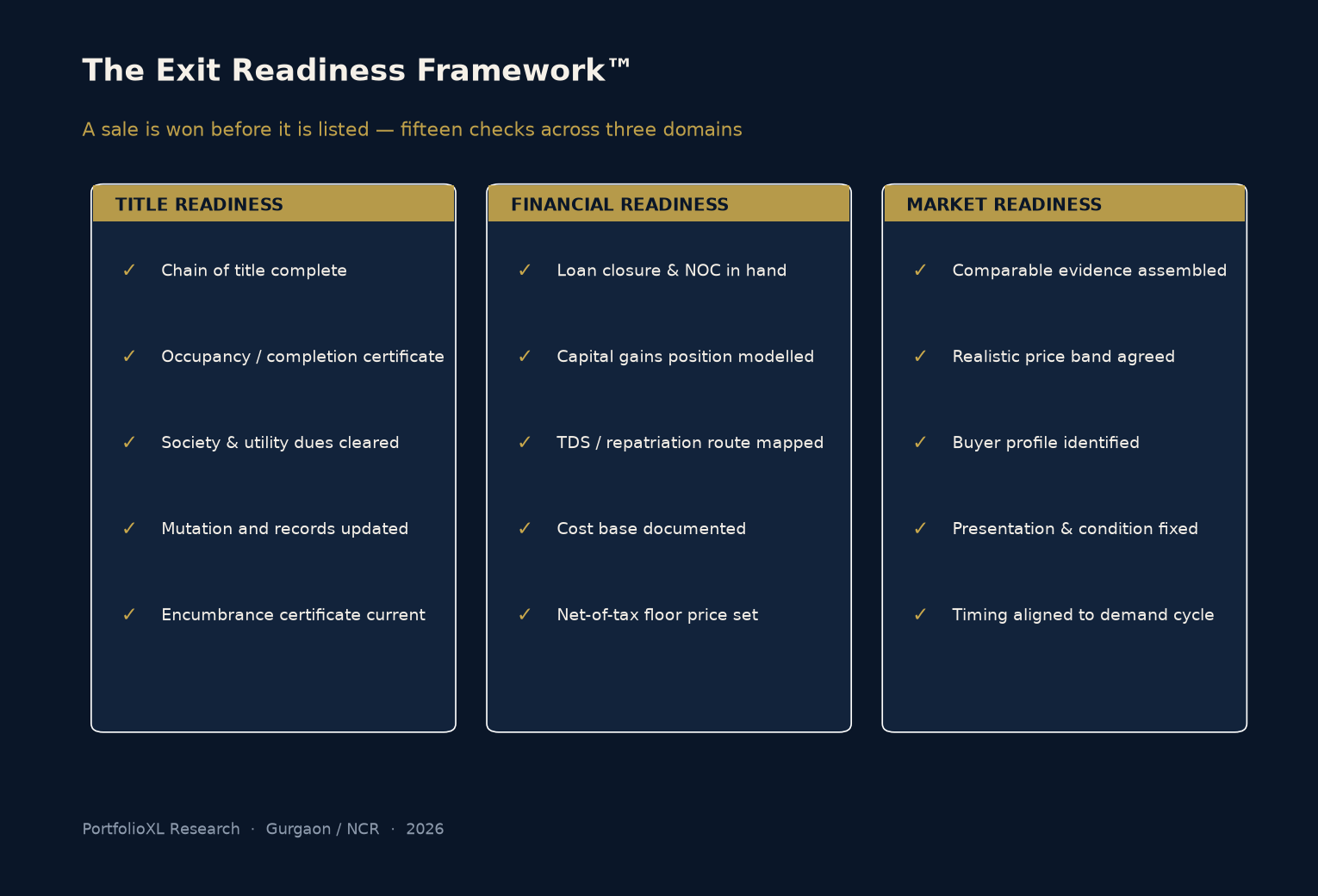
The Exit Readiness Framework™ — fifteen checks across title, financial and market readiness that determine whether a sale closes at the intended price.
We assess every holding across four dimensions, each scored out of 25. A total below 70 predicts a discounted or delayed exit with high reliability.
1. Documentary Readiness (25 points)
Clean chain of title across every prior transfer. Registered sale deed. Approved building plan and valid occupancy certificate. RERA registration where applicable. No-dues certificates from the developer, the maintenance agency and the utility providers. Full property tax history. Loan closure and a recorded release of charge where a mortgage existed.
Most sellers discover a defect here in week three of a live negotiation. The buyer discovers it at the same moment, and repricing follows.
2. Financial Readiness (25 points)
A defensible valuation supported by actual registered comparables, not asking prices. A capital gains computation prepared in advance, including the 12.5% no-indexation LTCG rate under the Finance Act 2024 regime retained in 2025 and, for residents holding pre-23-July-2024 property, the alternative 20%-with-indexation election. Reinvestment intent decided before listing, given the ₹10 Cr cap on Sections 54/54F and the ₹50 lakh cap on Section 54EC bonds.
For NRI sellers, this dimension is decisive. TDS applies on the sale consideration at rates materially higher than the resident position unless a lower-deduction certificate under Section 197 is obtained in advance. Applying after the buyer is identified adds six to ten weeks to closing — a delay that regularly costs the seller the buyer. Our NRI advisory desk sequences this before listing.
3. Asset Readiness (25 points)
Physical condition benchmarked to the best-presented unit in the same project, not to the seller''s own memory of it. Any tenancy either vacant on notice or documented as a registered, transferable lease with a credible covenant. Maintenance current. Society transfer rules understood, including transfer charges and any right-of-first-refusal provisions.
An occupied unit with an unregistered lease and an informal tenant is the single most common cause of a broken transaction in Gurgaon''s resale market.
4. Market Readiness (25 points)
An honest read of where the corridor sits in its cycle, using the stages described in the Value Creation Sequence. A defined buyer set — end-user, investor, NRI, corporate — because each values the same asset differently. Awareness of competing supply: fifteen similar resale units and an active developer launch in the same sector is a materially worse listing window than three units and no launch.
Market Analysis: The Structure of Resale Friction in Gurgaon
Gurgaon''s resale market is deep but slow, and the slowness is administrative rather than economic.
Buyer sophistication has risen sharply. Diligence that was once cursory now routinely covers title chain, approvals, encumbrance certificates, litigation searches and society dues. A defect that would have passed unnoticed five years ago now surfaces reliably — and buyers who find one defect assume others exist and price accordingly.
Supply timing matters more than most sellers accept. Where a developer has an active launch in the same sector, resale inventory competes against a new product with a payment plan, a fresh warranty and no diligence history. In corridors with heavy under-construction pipelines, resale sellers should expect longer marketing periods regardless of asset quality.
Rental documentation has become a valuation input. An asset with a registered lease to a credible corporate tenant now transacts to an investor buyer at a visible premium, because the income is verifiable. The same unit with an informal arrangement reverts to the thinner end-user buyer pool.
Portfolio Implications
Readiness has a term structure. Documentary readiness takes six to twelve months to fix and should be maintained permanently. Financial readiness takes two to three months. Asset readiness takes four to eight weeks. Market readiness cannot be created at all — only waited for. Sequencing matters: begin at the slowest layer.
Score before you need to sell. The purpose of the framework is to be ready when the market gives you a window, not to scramble when it does. Windows in Indian real estate open on infrastructure completions and close on supply waves; they rarely last more than three quarters.
Readiness should influence acquisition. Assets that are structurally hard to exit — irregular title chains, projects without occupancy certificates, unusually large or bespoke units, weak developer transfer processes — deserve a lower entry price, not merely a note of caution. The developer evaluation work belongs at purchase, because it determines exit friction a decade later.
A ready asset can be sold; an unready asset can only be marketed. That distinction determines whether an investor controls timing or the market does.
Risks and Counterarguments
Over-preparation has costs. Extensive renovation rarely recovers its cost in resale. Presentation and compliance recover; discretionary upgrades usually do not.
Vacating a tenant is not always correct. For an investor buyer, verified income is an asset. For an end-user buyer, an occupied unit is an obstacle. Decide the buyer set first, then decide the tenancy position.
Readiness does not defeat the cycle. A perfectly prepared asset in a corridor with two years of oversupply will still transact slowly. Readiness protects price; it cannot manufacture demand.
Who should not act on this now. Owners with no intent to transact within five years should maintain documentary readiness only, and ignore the rest until a window approaches.
The PortfolioXL View
We believe exit readiness is the most undervalued discipline in Indian real estate, precisely because no participant in the market is paid to provide it.
Developers are compensated at launch. Brokers are compensated at closing. Neither is compensated during the two to five years when readiness is actually built. The result is a market in which sophisticated buyers conduct institutional-grade diligence while sophisticated sellers arrive with a folder of photocopies.
Our recommendation is procedural. Score each holding on the four dimensions once a year. Fix the documentary layer permanently, since it is the slowest and the most damaging when defective. Prepare the tax computation before listing rather than during negotiation. And treat the decision to sell as separate from the decision to be able to sell — the second should always be true, whether or not the first ever becomes relevant.
Investors who do this stop negotiating from a position of urgency. That single change is usually worth more than any improvement in market timing.
To have your holdings scored against the Exit Readiness Framework, start with our portfolio health check or contact the advisory desk.