The Opportunity Window: How to Recognise the 18 Months That Determine a Decade of Returns
Corridors do not re-rate gradually. They re-rate in short, identifiable windows between the moment infrastructure becomes certain and the moment it becomes visible. Most investors arrive after the window closes.
Executive Summary
Real estate returns are not earned evenly across a holding period. They are concentrated.
In every corridor we have studied across the Gurgaon and wider NCR market, the majority of a decade''s capital appreciation is delivered inside a window of roughly twelve to twenty-four months. Before that window, prices drift with inflation and sentiment. After it, they consolidate at a new plateau and grow slowly again.
The investor question is therefore not "is this a good corridor?" — several are, permanently. It is "where is this corridor relative to its window?"
The Investment Thesis
Corridor re-rating happens between certainty and visibility — and almost never outside it.
Consider the sequence. An infrastructure project is announced; the market ignores it, correctly, because announcements in India frequently do not proceed. Then funding is allocated, contracts are awarded and construction begins. The outcome is now largely certain, but the asset is still an unfinished corridor with dust, poor access and thin social infrastructure. Prices lag.
Then completion arrives. Access improves visibly, retail follows, offices lease, and the corridor is suddenly obvious to everyone. Prices re-rate sharply over a compressed period.
The window is the gap between the two states. It opens when the outcome becomes certain and closes when it becomes visible. Investors who buy on announcement carry excessive execution risk. Investors who buy on completion pay for a re-rating that has already happened. The window is where risk-adjusted return concentrates.
This is the timing layer that sits on top of the Value Creation Sequence, which describes what happens to a corridor. The Opportunity Window describes when to act on it.
The Opportunity Window Framework™
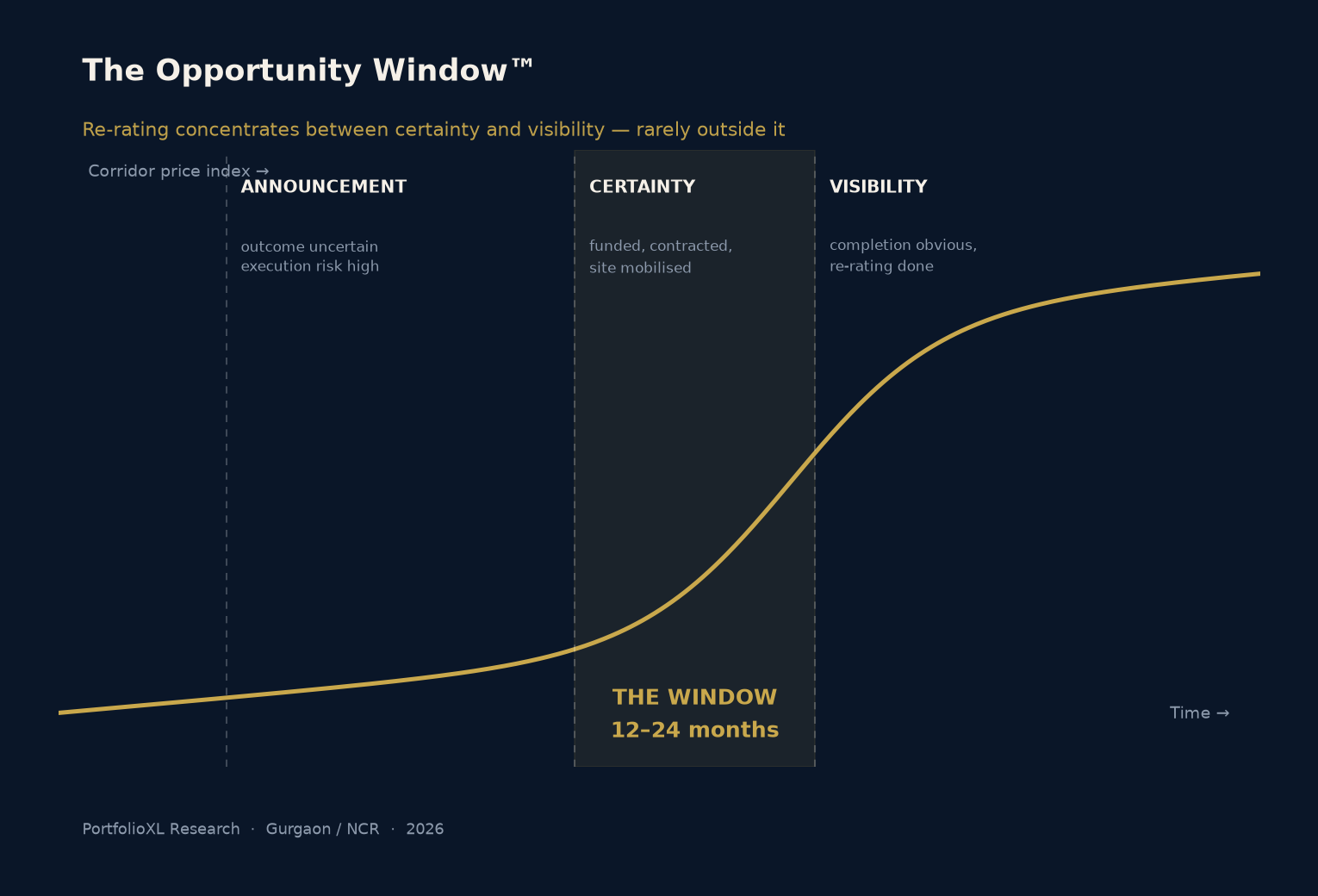
The Opportunity Window™ — corridor re-rating concentrates between the point at which an infrastructure outcome becomes certain and the point at which it becomes visible.
We score a corridor on five indicators. Windows open when three or more are present and close when the fifth appears.
Indicator 1 — Funded, not announced. Budget allocation, contract award and physical mobilisation on site. An announced metro line is a story. A tendered metro line with a contractor mobilised is a date.
Indicator 2 — Institutional land aggregation. Serious developers acquiring land parcels or entering joint developments ahead of price movement. Developer capital is better informed than retail capital and moves twelve to twenty-four months earlier. Track who is buying, not what is launching.
Indicator 3 — Price-to-adjacency discount. The corridor trades at a 30-45% discount to the adjacent mature corridor with which it will eventually share connectivity. Below a 20% discount, the window has likely closed. Compare current rates using our micro-market analysis and corridor comparison tools.
Indicator 4 — Launch velocity acceleration. New launches rising in count and in per-square-foot pricing, with early phases selling through. Rising launch prices from credible developers are the market''s clearest forward signal.
Indicator 5 — The closing bell: end-user migration. Occupancy rising, schools and retail opening, rental demand from residents rather than investors. This is the point at which the corridor becomes obvious. It is a wonderful place to live and a late place to enter.
Entry belongs where indicators 1 through 4 are present and indicator 5 has not yet arrived.
Market Analysis: Where Gurgaon Corridors Sit in 2026
Dwarka Expressway has largely passed through its window. Completion delivered the re-rating; the discount to established corridors has compressed and end-user migration is well underway. It is now a hold-and-yield corridor rather than an entry-stage one.
Southern Peripheral Road is in the late stage of its window. Institutional developers have committed, launch pricing has moved materially, and the adjacency discount to Golf Course Extension has narrowed. We wrote about this transition in detail in our SPR outlook. Entry here is still defensible; it is no longer early.
New Gurgaon and the sectors along the Northern Peripheral belt show a mixed signature — funded infrastructure, active aggregation, a real adjacency discount, but uneven end-user absorption across sectors. This is where sector-level selection matters far more than corridor-level conviction.
The emerging Sohna and southern extension belt sits earlier: infrastructure funded and partially delivered, developer interest visible, discount wide, end-user migration limited. Higher execution risk, longer holding period, and the widest window still open.
Two forces have shortened windows across all of them. Information moves faster: RERA disclosure, transaction data and developer announcements reach retail investors within weeks rather than years. And developer capital has become more concentrated and more decisive, which compresses the land-aggregation phase. A window that lasted three years in 2010 lasts twelve to eighteen months in 2026.
Portfolio Implications
Windows dictate allocation weight, not participation. A corridor inside its window justifies an overweight position. A corridor past it justifies a normal-weight yield holding — not exclusion.
Match the instrument to the window. Early in a window, under-construction inventory from a credible developer offers the highest leverage to the re-rating, at the cost of execution risk and illiquidity. Late in a window, ready assets in established societies with verifiable rental income are the better risk. The instrument choice should follow the timing, not the other way round.
Fund the entry from a closed window. The cleanest source of capital for an opening window is an asset in a corridor whose window shut years ago. This is the point at which the Opportunity Window and the disposal discipline described in the Dead Capital Framework meet.
Size for a five-to-eight year hold. Windows compress appreciation, but realisation still requires the corridor to mature. An investor who cannot hold through completion should not enter at the window at all.
Confirm exit readiness before entry. A corridor position acquired inside a window and held in an asset that cannot be sold cleanly converts timing skill into a paper gain. Apply the Exit Readiness Framework at purchase.
Risks and the Bear Case
Infrastructure slips. Indian infrastructure timelines extend routinely. A window can stay open for years longer than expected, and the opportunity cost of waiting inside it is real. Requiring funding and mobilisation rather than announcement reduces this risk but does not remove it.
Supply can absorb the re-rating. If developers launch aggressively into a window, new supply can cap price movement even when demand arrives as forecast. Sectors with very high launch density deserve a discount to the framework''s signal.
False windows exist. A single announcement, a single large launch, or a burst of speculative interest without funded infrastructure can imitate the pattern. The funding test is the discriminator; nothing else in the framework substitutes for it.
Who should ignore this. End-users buying a home to live in should optimise for life, not for entry timing. Investors who cannot tolerate five to eight years of illiquidity should stay in mature, yield-producing corridors and accept lower appreciation.
The PortfolioXL View
We believe timing in real estate is neither impossible nor mystical — it is simply unglamorous. It requires tracking funded infrastructure, land registries, developer behaviour and adjacency discounts rather than sentiment, launches and advertising.
The market''s incentives run the other way. The heaviest marketing in any corridor arrives when it has already become visible, because that is when inventory is easiest to sell. Retail capital therefore reliably enters at indicator five. This is not a failure of intelligence; it is a failure of information sequencing, and it is correctable.
Our advice is to hold a standing view on where each corridor you care about sits, review it when infrastructure milestones complete, and be willing to act inside a window even when the corridor still looks unfinished. Discomfort at entry is usually the price of the re-rating.
An investor who enters two windows correctly across a decade will outperform one who owns better assets in corridors that have already re-rated. Timing the stage matters more than picking the project.
For a current read on where each Gurgaon corridor sits, see our investment radar and micro-market intelligence, or speak with our advisory desk.